
Leadership isn’t what you do. It’s how people experience you.
07
Oct
2026
Written by Annabelle O’Donnell, Managing Consultant & Design Thinking Lead
Over the past decade, my work has spanned international business advisory, strategy, innovation, diplomacy, organisational change and more recently, leadership development. Throughout much of that career, design thinking has been a core part of my practice.
I first learned design thinking as a way to solve complex problems and design solutions that meet the needs of an end-user. At its core, design thinking is a human-centred approach to problem solving. It starts by understanding the people affected by a problem, uses that insight to challenge assumptions and define what really needs to be solved, then develops, tests and refines ideas through experimentation and feedback.
At the time, I thought I was learning an innovation methodology. Looking back, I was also learning a mindset for understanding people, change and uncertainty. The more time I now spend working with leaders and teams, the more convinced I am that we should apply that same mindset to leadership development.
Leadership is fundamentally human. Leaders are constantly making choices about people, often with incomplete information. They make assumptions about what their teams need, interpret how people are responding and try behaviours without knowing exactly how they will land.
A design thinking mindset gives leaders a practical way to navigate that complexity. It encourages them to understand the experience of the people they lead, question what they think they know, experiment with their behaviour and learn from the impact.
In other words, it shifts leadership development from simply asking “What kind of leader do I want to be?” to also asking “How is my leadership being experienced and what can I learn from that?”
That matters even more as organisations navigate AI, changing customer expectations, new technology, workforce shifts and continuous transformation. Organisations cannot know exactly what is coming next. They need to be able to learn and adapt as they go.
But organisations do not become adaptable because a strategy says they should. Strategy is translated into action through the everyday behaviours of leaders: how they create the conditions for people to relate, make decisions, respond to uncertainty, experiment and learn.
So what changes when we bring a design thinking mindset into leadership development?
Leadership is experienced, not intended
Leadership is about creating the conditions for other people to perform at their best. A leader can intend to create trust, clarity or psychological safety, but it is how those conditions are experienced that ultimately shapes behaviour.
A moment from a recent leadership session stayed with me. A General Manager shared her vision with her executive team. Afterwards, we asked the team to reflect back what they had heard. Their answers were surprisingly different.
The leader realised that only around half of what she thought she had communicated had landed in the way she intended.
It exposed a gap leaders can easily miss: the gap between intention and experience.
A leader may intend to give someone autonomy, while that person experiences a lack of direction. They may think they are creating urgency, while the team experiences anxiety. A message may have been communicated several times without creating clarity.
Design thinking asks us to understand an experience from the perspective of the person we are designing for. Leadership development can do the same.
Bring the people experiencing your leadership into the development process
Leadership development understandably asks leaders to reflect on themselves: What are my strengths? What do I need to work on? What kind of leader do I want to be?
A design thinking mindset adds another lens: Who is experiencing my leadership, and what is that experience like for them?
There is no generic employee.
It might be a new graduate deciding whether it is safe to speak up. A high performer looking for more autonomy. A first-time manager who needs greater clarity. A remote employee who feels removed from decisions. There are also customers and stakeholders experiencing the downstream effects of how that team is led.
Design thinking gives us practical ways to bring those perspectives into the development process. Personas can help leaders recognise that different people may experience the same behaviour differently. Stakeholder mapping can identify whose experience matters in a particular leadership challenge. Empathy interviews can replace assumptions about what people need with direct insight from them.
Instead of simply deciding, “I need to communicate better,” a leader can ask:
"Who needs greater clarity from me? What does clarity look like for them in this context? What am I assuming about what they already understand? How could I find out?"
That creates amuch more useful starting point for behaviour change.
What do you know,and what are you assuming?
Leaders make assumptions constantly.
Why someone is resisting change. What motivates a team member. Whether people understand the strategy. What a customer needs. Why performance has changed.
The problem is not that leaders make assumptions. We all do. The risk comes when an assumption is treated as fact.
Design thinking encourages us to make assumptions visible so they can be examined and tested.
What do we know? What are we assuming? What evidence do we have? How could we find out?
That distinction can fundamentally change a leader’s response.
A leader who assumes someone is resistant to change may push harder. A leader who gets curious may discover that the person is confused, unconvinced, worried about the consequences or simply missing information.
Making assumptions visible creates space for curiosity and more conscious leadership choices.
A workshop is the catalyst, but experimentation turns insight into behaviour change.
This is perhaps the biggest opportunity I see for applying a design thinking mindset to leadership development.
No product leader or service designer would run a workshop, take whatever came out of the room and launch it as the finished product. A design thinking workshop might help a team understand a problem, generate ideas and develop a prototype. But the real learning comes from what happens next: testing it, gathering feedback, noticing what works and refining the approach.
Leadership development is no different.
A workshop can create insight, surface assumptions and give leaders opportunities to learn and practise. But insight alone does not change behaviour.
Leaders need to take what they have learnt back into their everyday work, try something different, notice the impact, seek feedback and adjust.
Rather than leaving a program thinking “I need to delegate more,” treat it as an experiment.
Delegate something differently with one person. Notice what happens. Ask how they experienced it. What worked? What did not? What would you change next time? Then try again.
Over time, small experiments become new behaviours and, eventually, new habits.
Four practices, not four answers
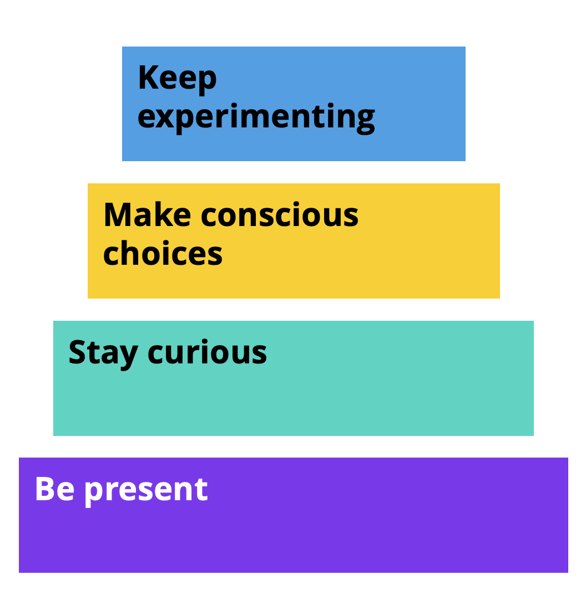
This connects closely with LIW’s 4 Practices: Be Present. Stay Curious. Make Conscious Choices. Keep Experimenting.
They are called practices because leaders strengthen them by using them.
Being present helps leaders notice what is happening. Staying curious helps them question assumptions and understand other perspectives. Making conscious choices helps them respond with intent rather than habit. Keeping experimenting helps them learn from the impact of those choices.
The mindset is closely aligned with design thinking.
A meeting becomes an opportunity to try a different behaviour. A difficult conversation becomes an opportunity to test an assumption. A one-to-one becomes an opportunity to understand how your leadership is being experienced.
Developing leaders with a design mindset
Design thinking does not need to become another methodology bolted onto leadership development. Its value is in the mindset it brings.
Start with people. Get curious about their experience. Make assumptions visible. Try something. Learn from what happens. Adjust. Try again.
Those behaviours matter for individual leaders, but they also matter at an organisational level. Organisations become more adaptable when their people are able to question assumptions, learn quickly, experiment safely and respond to what they discover.
Leadership creates the conditions for those behaviours.
The questions I would leave leaders with are:
Who is experiencing your leadership? How are they experiencing it? What are you assuming that you have not tested? What could you try differently? And what could you learn from what happens next?
If you are interested in exploring how a design thinking mindset could strengthen leadership development in your organisation, get in touch or follow me on LinkedIn.
%20(1).png)
.png)
