A Tale of Under 13s Soccer (and why your leadership training doesn’t stick)
02
Sep
2026
Written by Andy Chevis, Chief Learning Officer
.jpg)
I have spent a lot of hours standing on the sideline of a soccer field.
My son plays soccer (football for my Northern Hemisphere friends), a fair bit of it. School team, club (first grade and second grade), and a summer league on top of that. So, I have had plenty of time to notice something odd. He is not the same player from team to team.
Put him in one team and he plays with real freedom. He is composed under pressure and willing to try things, and there is a noticeable jump in his accuracy, the kind of touch and decision making you would not expect from a twelve-year-old. What strikes me most is that he is a generous player. He seems genuinely happy to find the right teammate, in the right position, and set them up rather than take the shot himself. He reads the game and plays his role well without needing to be the one in the spotlight.
Put him in a different team, and something changes. He misses passes he would normally make. He loses the ball more. I can see his confidence drain in real time, a little more with every mistake, until by the second half he is playing tentatively, almost apologetically. He’s kind of half-hearted and this is weird because he LOVES soccer.
You could put this down to coaching. In one of his club teams, he has a genuinely excellent coach, so that is probably part of the story. But in his other club team, and in his summer league, the coach is another parent, doing their best without much of a playbook. And at school, there is barely any coaching at all. Same boy. Wildly different level of instruction. As a learning and development practitioner, I wish I could say it was about the coach. And yet the pattern holds. It is not really about the coach.
It is about the team around him. The trust. How teammates respond when he makes a mistake. Whether the players around him are organised in a way that gives him options or leaves him isolated. Capability is constant. Opportunity (and therefore performance) is not.
Why This Matters Beyond the Pitch
I can’t stop thinking about this in relation to work I do every day, helping leaders develop, and then watching, often with some a hint of sadness, as they struggle to translate their insights and motivation into changed behaviour back in the business.
We have all seen it. A leader goes through a brilliant development program. They understand the models. They can articulate the theory of great coaching, or inclusive decision making, or giving better feedback, they’ve even practiced a bit and had some results, so it’s not just theory. They leave the room genuinely committed to doing things differently.
And then, three weeks later, little has changed.
For a long time, the leadership development industry has treated this as a motivation problem, or occasionally a capability problem. Send them on more training. Make the content stickier. Add a follow up module. But my son's soccer season is a pretty good reminder that this framing misses something important. Sometimes the person has not lost the skill or the will. Sometimes the team around them has changed.
A Model Worth Borrowing
There is a piece of behavioural science that explains this cleanly, even if it wasn’t specifically designed with leadership development in mind. The COM-B model, developed by Susan Michie and colleagues, argues that behaviour is the product of three things interacting together. Capability, the psychological and physical ability to do the behaviour. Opportunity, the external factors that make the behaviour possible, whether physical or social. And Motivation, the conscious and unconscious processes that drive us toward one action over another.
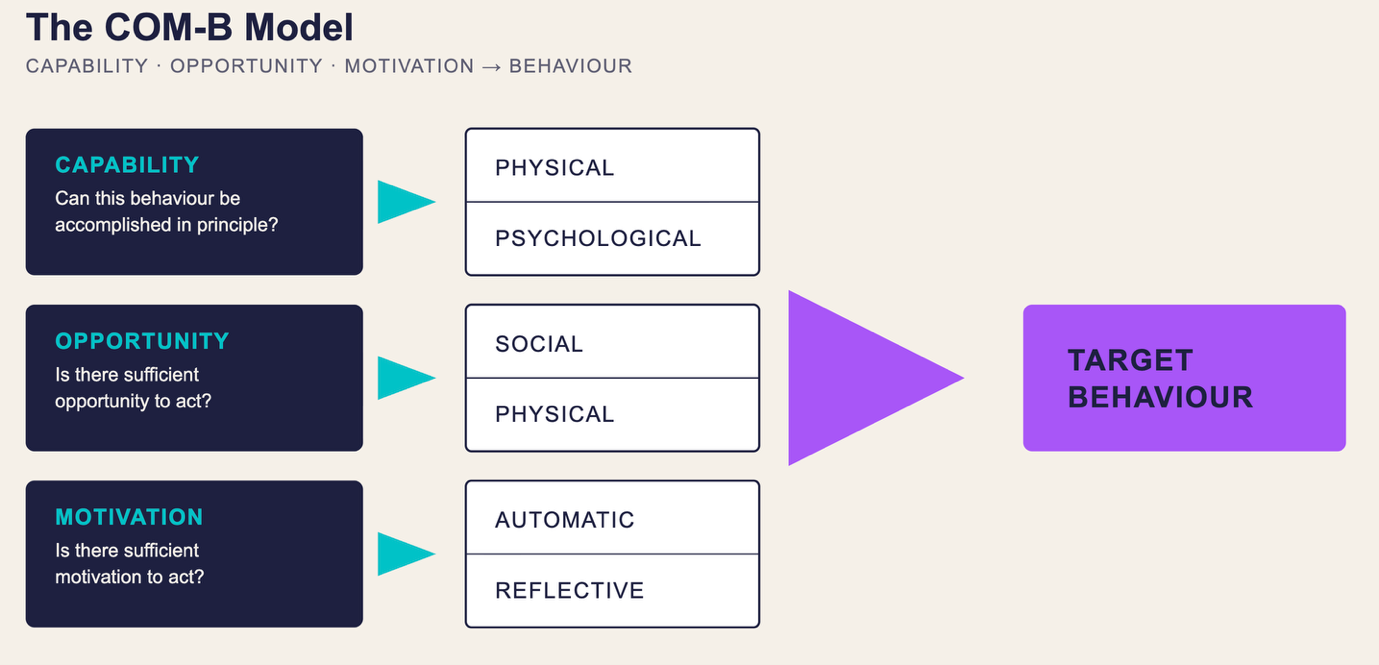
The insight that matters most for us is a simple one. All three need to be present, at the same time, for behaviour change to happen. You cannot train your way past a broken opportunity. You cannot motivate your way past a missing capability. And crucially, capability that shows up brilliantly in one context can collapse in another, not because the person has changed, but because the opportunity around them has.
That is exactly what I watch happen on a soccer field most weekends. My son's capability is the same across every team. What varies is the opportunity, the social permission to take a risk, the trust that a mistake will not be punished, the way other players position themselves to receive what he has to offer. When that opportunity is present, motivation follows naturally. He wants to play, wants to try the audacious pass, wants to set someone else up. When it is missing, motivation drains away almost as fast as confidence does.
Where Leadership Development Usually Gets It Wrong
Most leadership programs are, in COM-B terms, almost entirely capability interventions. We teach the skill. We build the model. We might even run some practice scenarios. All useful. All necessary. And almost always insufficient on their own.
What we do far less often is design deliberately for opportunity, the working conditions a leader returns to. Does their manager expect and reward the new behaviour, or quietly reinforce the old one? Do their peers behave in ways that make the new approach easier or harder? Is there a physical or structural barrier, no time, no forum, no process, that makes the behaviour almost impossible even for someone who wants to do it?
This is where the enabling conditions in a business really live, and it is the piece that gets skipped when development is treated as a training event rather than a system. Clarity plays a role here too. Not just clarity of the skill itself, but clarity about what conditions leaders can expect to return to, and what will be different about how success is recognised.
What Embedding Actually Requires
If we take COM-B seriously, embedding leadership behaviour in day-to-day work is not primarily a content problem. It requires attention to the conditions around the leader, in the same way the team around my son determines whether his skill shows up or disappears.
That means looking at who a leader reports to, and whether that person's own behaviour will reinforce or quietly undo what was just learned. It means looking at peer dynamics, because behaviour change rarely survives in isolation when the surrounding culture pulls the other way. It means removing the practical obstacles, the missing time, the absent forums, the unclear expectations, that process or system that, in truth,s works against the new behaviour the leader is trying to apply, all the things that make that new behaviour structurally difficult regardless of how motivated someone is. And it means being honest that motivation is often a symptom, not a cause. When we see a leader who seems to have lost their drive to apply what they learned, the more useful question is rarely "why don't they want to," and much more often "what has changed around them that makes it hard."
The Real Job
None of this makes the training pointless. My son still needs the skill. Development still matters enormously. But skill alone was never going to be the whole story, on the pitch or in the business.
The real job of anyone serious about leadership development is not just building capable people. It is building the team, the system, the conditions, around them, so that the capability they have developed gets a chance to show up.
I think about this every weekend, watching a boy who is the same player, wearing a different shirt, and somehow becoming someone else entirely depending on who is standing next to him. And I talk about it with all our clients, because I’m interested in how the leaders we work with perform on the field, rather than how much they enjoyed the training session.
What does the team around your leaders actually make possible for them?
.png)